
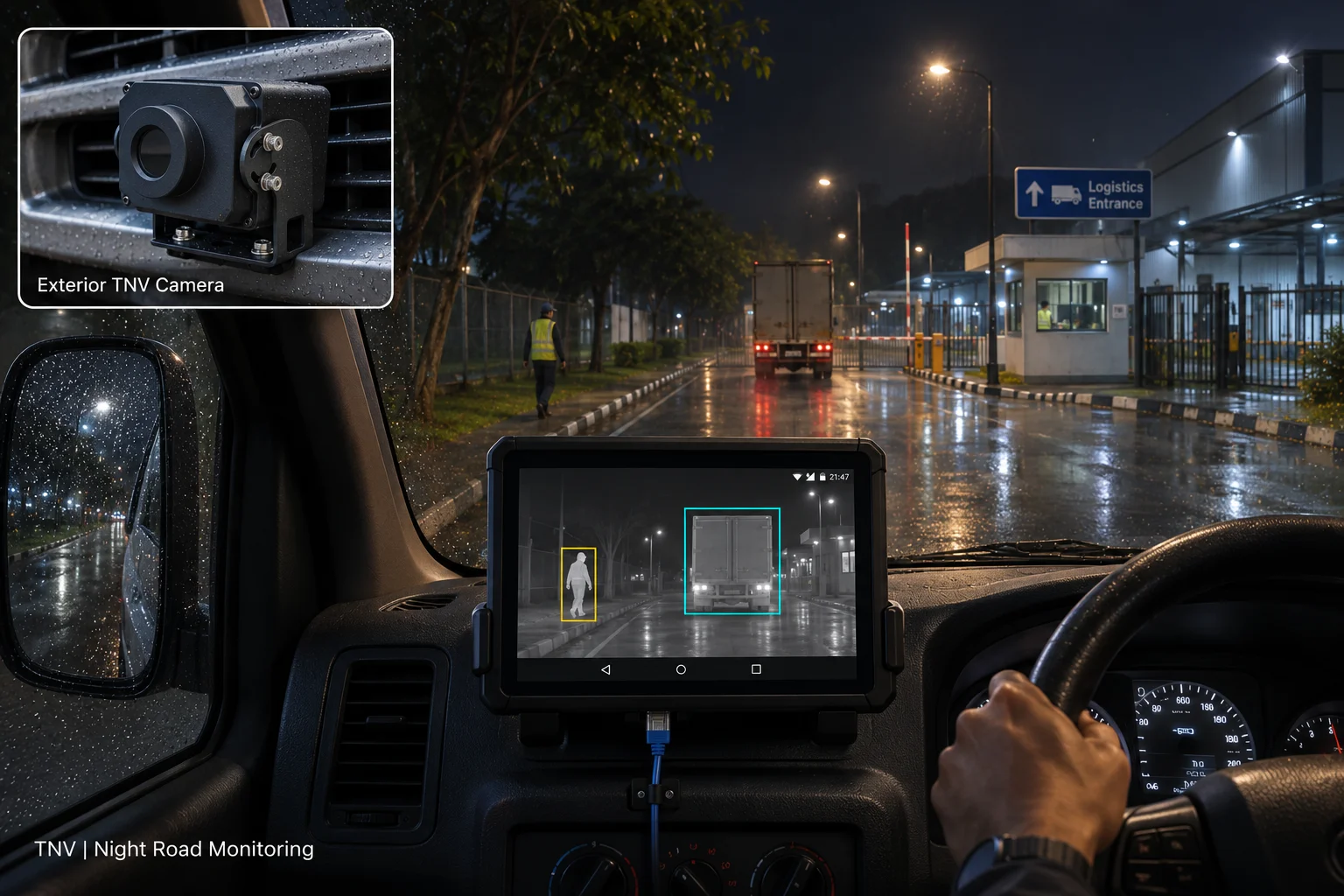
Yes, a thermal camera add-on can deliver measurable value for Malaysian commercial fleets. That value depends on one condition: operational conditions and budget must align.
The unit is a thermal camera component. It outputs AHD video and RS485 person and vehicle detection data. It integrates with an existing blind spot monitoring setup. It is not a complete safety system on its own.
Three factors should guide your decision. Review your driving environment, your vehicle types and route profiles, and total cost against expected safety gains.
This post compares thermal against radar, ultrasonic, and standard cameras under Malaysian conditions, including night, rain, haze, and glare.
Key Takeaways
Thermal cameras add a detection layer to your existing blind spot system.
They work best at night, in haze, or when glare blinds standard cameras.
Run a small pilot first to test performance on your routes.
Check JPJ and PUSPAKOM rules before you buy or install.
Weigh lifetime costs against avoided accidents and downtime.
Existing Blind Spot Monitoring and the Thermal Gap
What Radar, Ultrasonic, and Cameras Cover
Radar units excel at detecting moving objects at distance and estimating relative speed. They perform well in rain and darkness, which suits highway lane-change warnings. Ultrasonic sensors fit low-speed maneuvering, such as reversing and tight urban docking, where short-range accuracy matters most. Standard cameras deliver visual context that sensors cannot, and drivers use that footage to judge clearance and confirm hazards.
Each technology has a defined role within a blind spot monitoring system. Radar handles the long-range alert. Ultrasonic covers the close perimeter. Cameras provide the visual record. None of these options is weak; each is engineered for a specific detection task.
Where a Thermal Component Adds Value
The thermal unit is a camera component. It outputs AHD video and RS485 person and vehicle detection data. It must integrate with the existing blind spot monitoring setup. It does not replace the system, and it is not a standalone safety system.
Blind spots remain a risk even in good visibility. A standard camera can miss a pedestrian in deep shadow or a vehicle against low sun. Thermal imaging reads heat signatures, so it can distinguish people and vehicles from the background in these conditions. That is the gap the component fills: a supplementary detection layer that feeds video and detection data into the system already on the vehicle.
Thermal Performance in Malaysian Conditions
Night, Rain, Haze, and Glare
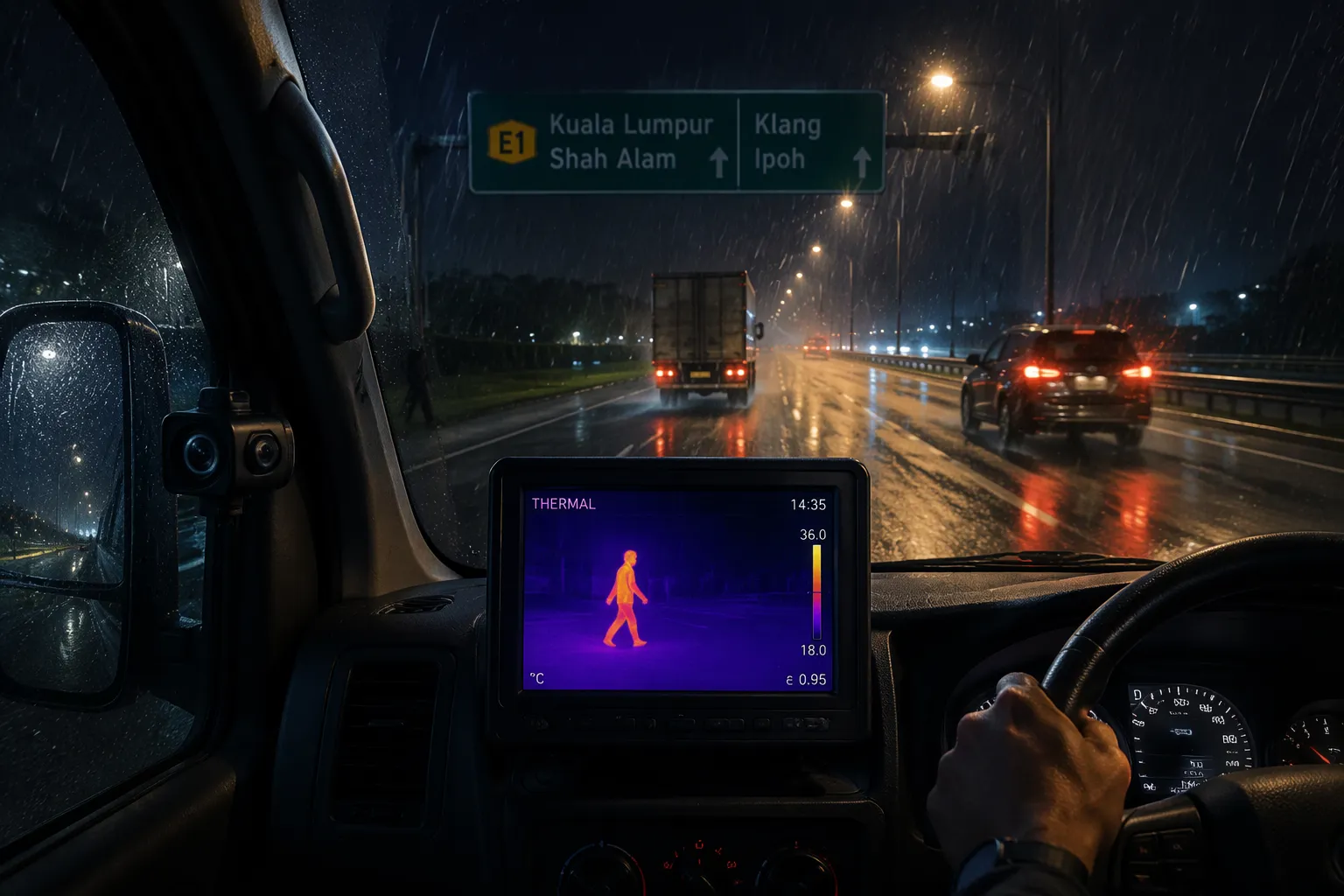
Malaysian roads test every sensor type. A long-haul driver leaves Johor Bahru after midnight and meets unlit stretches on the North-South Expressway. An urban delivery van works through a monsoon downpour in Klang Valley traffic. A plantation support truck moves through haze that cuts visibility to a few hundred meters. Each condition stresses a different part of a blind spot monitoring system.
Long-wave infrared, or LWIR, thermal imaging reads heat rather than reflected light. This matters at night, when a standard camera depends on headlights or street lighting to build an image. A pedestrian in dark clothing beside an unlit road stays nearly invisible to a standard camera. The same person emits body heat, and an LWIR sensor can register that contrast against a cooler background. The same principle applies in haze and smoke, where airborne particles scatter visible light but interfere far less with thermal radiation.
Rain presents a mixed picture. Heavy rain reduces thermal contrast between a warm vehicle and a warm road surface, and water on the lens can blur the scene. Thermal imaging does not see through rain the way some buyers expect. What it does offer is a second detection channel that does not depend on visible light. Glare from low sun or oncoming high beams can wash out a standard camera image. A thermal sensor is largely unaffected by that glare, so it keeps producing usable video when a visible-light camera struggles.
Frame rate is another practical factor. Thermal modules can output video at faster frame rates than many standard cameras, which helps track a moving person or vehicle across the frame. Treat this as supporting context, not a guarantee. Actual performance depends on the specific module, the mounting position, and how the detection data is processed downstream.
Technical Limits and Complementary Roles
Thermal imaging has real limits. It cannot read a license plate, identify a vehicle color, or show lane markings. It performs poorly when the scene has uniform temperature, such as a warm truck against a sun-heated road. It also cannot measure distance or relative speed the way radar does. These limits define its role.
The thermal component complements radar, ultrasonic, and standard cameras. Radar still handles long-range moving-object detection and speed estimation. Ultrasonic still covers the close perimeter during low-speed maneuvering. Standard cameras still provide the visual record drivers use to judge clearance. The thermal unit adds a detection layer that works when visible light fails, and it feeds AHD video plus RS485 person and vehicle detection data into the existing setup.
A fleet operator should think in layers. No single sensor covers every condition, and the strongest configuration combines technologies so that one covers the weakness of another. Thermal earns its place in that stack when night, haze, or glare conditions dominate the route. On a route that runs only in daylight and clear weather, the marginal gain is smaller, and the budget may be better spent elsewhere.
Application Fit by Vehicle and Route
Long-Haul and Night Operations
Long-haul fleets run the routes where thermal earns its keep. Prime movers and trailers on overnight trunk routes face unlit highway stretches, fatigue-dimmed attention, and mixed traffic that includes motorcycles with weak lighting. Police data recorded 5,939 fatalities out of 585,729 accidents as of last November, and almost 70% of those involved motorcyclists. A thermal component that outputs RS485 person and vehicle detection data gives the existing blind spot monitoring setup a second detection layer for exactly these road users.
The Road Transport Department director-general, Datuk Aedy Fadly Ramli, said last December that blind spots are among the five main causes of accidents involving heavy vehicles. For a fleet running night trunk routes, that statement frames the business case. The thermal unit adds heat-based detection where standard cameras depend on headlights and street lighting. Operators with predominantly daylight, short-haul schedules will see a smaller marginal gain.
Urban Delivery and Heavy-Rain Routes
Urban delivery vans and light trucks work a different profile. Routes are short, stops are frequent, and the risk concentrates at low speed around pedestrians, cyclists, and parked vehicles. Monsoon downpours cut visible-light contrast and produce glare from wet surfaces. A thermal component keeps producing usable video in these conditions, and it feeds that video into the blind spot monitoring system already fitted to the vehicle.
Studies cited in industry reporting suggest sensor, radar, and camera systems can reduce lane-change crashes by up to 14%. Treat that figure as directional context for the whole system, not a promise for any single component. A delivery fleet in the Klang Valley should weigh the thermal add-on against its rain-season incident pattern. A fleet with few night runs and mild weather exposure may find the budget better placed in driver training or standard camera coverage.
Regulatory and Approval Considerations
Type Approval and Device Standards
A thermal camera component enters a regulated space. ISO 17387:2008 sets out performance requirements and test procedures for lane change decision aid systems, which is the international reference point for blind spot detection. That standard gives fleet owners a common vocabulary when they compare supplier claims. It does not, by itself, certify any product for Malaysian roads.
Vehicle modification rules and device approval pathways vary by vehicle class and by how the component integrates with the existing system. [Confirm with JPJ and PUSPAKOM whether the thermal unit requires separate type approval or falls under the existing blind spot monitoring approval for your vehicle category.] A component that only outputs AHD video and RS485 detection data may follow a different pathway than one that actively intervenes in vehicle control. Verify this before purchase, not after installation.
Incentives and Compliance Pathways
Fleet operators should also check whether any incentive or compliance program applies to their operation. [Verify current Malaysian incentive schemes for commercial vehicle safety equipment, including any tax treatment or fleet modernization program, with the relevant agency.] Program terms change, and eligibility often depends on vehicle type, fleet size, and route classification.
Compliance is not only a paperwork exercise. A documented approval trail supports insurance claims and protects the fleet during roadside inspection. Build the approval question into the pilot scope. Ask the supplier for test documentation tied to a named standard, and confirm that the installation does not void any existing vehicle warranty or permit condition. A clear compliance path reduces the risk that a technically sound upgrade becomes an operational liability later.
Cost, Installation, and ROI
Upfront and Lifetime Cost Components
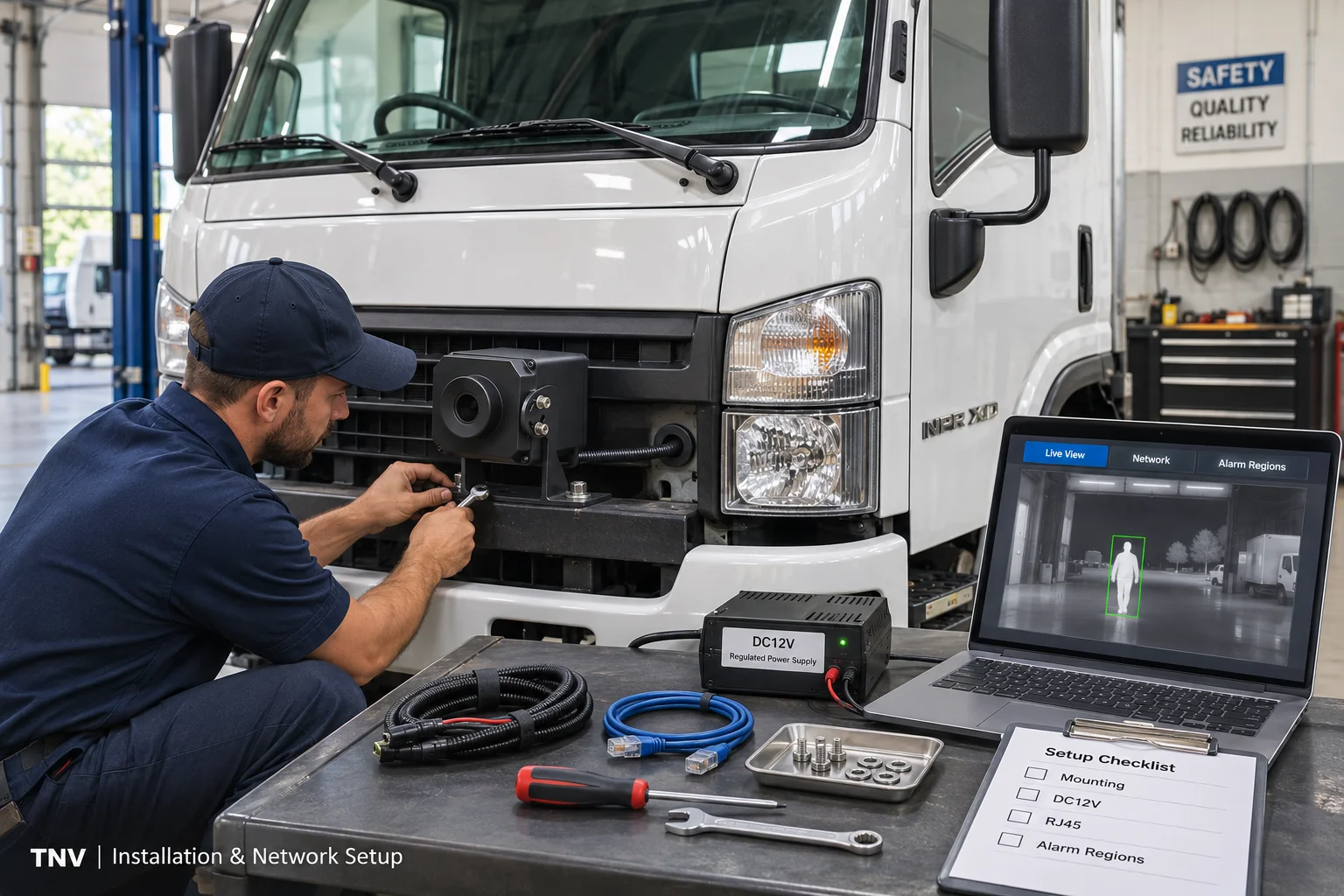
A thermal upgrade carries cost at three stages. The first is the purchase price of the camera component itself. The second is installation labor and any mounting hardware needed to fit the unit alongside the existing blind spot monitoring sensors. The third is ongoing maintenance across the service life of the vehicle.
The purchase price varies with resolution, frame rate, and the detection firmware bundled with the module. A higher-specification unit costs more, and it may deliver detection data that a basic module cannot. Buyers should compare modules on the same specification sheet before comparing price.
Installation cost depends on how the unit integrates with the existing system. A component that outputs AHD video and RS485 detection data must connect to the display and processing unit already on the vehicle. Where the existing harness has spare capacity, installation is simpler. Where it does not, additional cabling and labor raise the bill. Fleets should ask the supplier for an installation scope before committing.
Lifetime cost includes cleaning, calibration checks, and replacement of any unit damaged by stone strikes or vibration. Thermal lenses need periodic cleaning to keep image quality stable. These costs are modest per vehicle, but they compound across a fleet. A total cost of ownership view, not the sticker price alone, gives the accurate comparison.
Savings from Reduced Accidents and Downtime
Savings are harder to quantify than costs, and buyers should treat any projection with caution. The clearest gains come from avoided collisions. A prevented blind spot incident avoids repair cost, third-party liability, and the administrative burden of a police report and insurance claim. For heavy vehicles, the liability exposure in a collision with a motorcyclist is substantial.
Downtime is the second savings channel. A vehicle off the road for accident repair earns nothing while the fleet still pays for finance, insurance, and driver costs. Faster return to service protects revenue. A thermal component that reduces night-time incident frequency contributes to that outcome, though the effect depends on route profile and driver behavior.
Fuel and insurance effects are possible but not guaranteed. Some insurers offer favorable terms for fleets with documented safety equipment, and that is worth checking with the broker. Do not build the business case on an assumed discount. Build it on avoided incidents and protected uptime, then treat any insurance benefit as upside.
A conservative approach works best. Estimate the current annual incident rate for the fleet, assign a realistic cost per incident, and apply a modest reduction assumption. If the thermal add-on still pays back within an acceptable period under that conservative case, the investment is sound. If it only pays back under optimistic assumptions, the fleet should reconsider scope or timing.
Pilot Scope and Delivery
What a Trial Deployment Includes
A scoped pilot tests the thermal component on a small number of vehicles before the fleet commits to a full rollout. The pilot should integrate the unit with the AHD video feed and RS485 detection data already flowing through the existing blind spot monitoring setup. Fit the component to a representative sample of vehicles, not the newest units in the yard. The sample should reflect the routes where the business case is strongest, such as night trunk runs or monsoon-season delivery loops.
Define evaluation criteria before installation begins. Useful measures include the number of detection events logged per shift, driver feedback on image clarity at night and in rain, and any change in near-miss reports. Set decision gates at fixed intervals, for example a review after the first month and a final assessment at the end of the trial. Each gate should answer one question: does the observed performance justify the cost of wider deployment? Keep the criteria simple enough for operations staff to record without extra training.
Approval Conditions and Post-Pilot Support
The pilot should confirm the approval position before any wider purchase. [Verify with JPJ and PUSPAKOM whether the thermal unit needs separate type approval or falls under the existing blind spot monitoring approval for your vehicle class.] Confirm that installation does not affect warranty or permit conditions. A pilot that clears these questions early protects the fleet from a costly reversal later.
Post-pilot support deserves the same attention as the hardware. Ask the supplier for a clear support term covering firmware updates, replacement of failed units, and response time for technical queries. Confirm who handles cleaning and calibration checks during the trial. A supplier who supports the pilot well is likely to support the fleet well after rollout. Commercial feasibility rests on these terms, not on the demonstration alone.
The verdict stays qualified. A thermal component pays off when night, haze, or glare dominates your routes and your budget covers integration plus lifetime upkeep.
Fleet priority | Suitable configuration |
|---|---|
Night long-haul | Thermal add-on layered onto existing blind spot monitoring |
Urban rain routes | Thermal plus standard cameras, radar retained |
Budget-constrained | Standard cameras first, thermal deferred |
Run a scoped pilot before full rollout. Weigh compliance approval and lifetime cost, not sticker price alone.
Assess your fleet profile against this matrix. Match the configuration to your actual routes, then decide.
FAQ
Does a thermal add-on replace radar or standard cameras?
No. The unit is a camera component. It outputs AHD video and RS485 person and vehicle detection data into the existing blind spot monitoring setup. Radar still handles long-range moving-object detection. Ultrasonic still covers the close perimeter. Standard cameras still provide the visual record. Thermal adds a detection layer for low-light and low-contrast conditions.
Which routes justify the upgrade?
Routes where night, haze, or glare dominates the driving task justify the spend. Long-haul trunk runs after dark fit best. Monsoon-season urban delivery loops also qualify. Daylight-only, short-haul operations see a smaller marginal gain. Match the configuration to your actual route profile before you commit budget.
What does the pilot need to prove?
The pilot must show that the component integrates cleanly with the existing AHD and RS485 feeds. It must log detection events across real shifts. It must confirm the approval position for your vehicle class. Set decision gates at fixed intervals. A pilot that clears these questions protects the fleet from a costly reversal.
How should we treat the cost case?
Build the case on avoided incidents and protected uptime. Estimate your current annual incident rate and assign a realistic cost per incident. Apply a modest reduction assumption. Treat any insurance benefit as upside, not base case. If payback only works under optimistic assumptions, reconsider scope or timing.
Is the thermal unit approved for Malaysian roads?
[Verify with JPJ and PUSPAKOM whether the unit needs separate type approval or falls under the existing blind spot monitoring approval for your vehicle class.] ISO 17387:2008 is the international reference for lane change decision aid systems. It gives a common vocabulary for supplier claims. It does not certify any product for Malaysian roads by itself.