
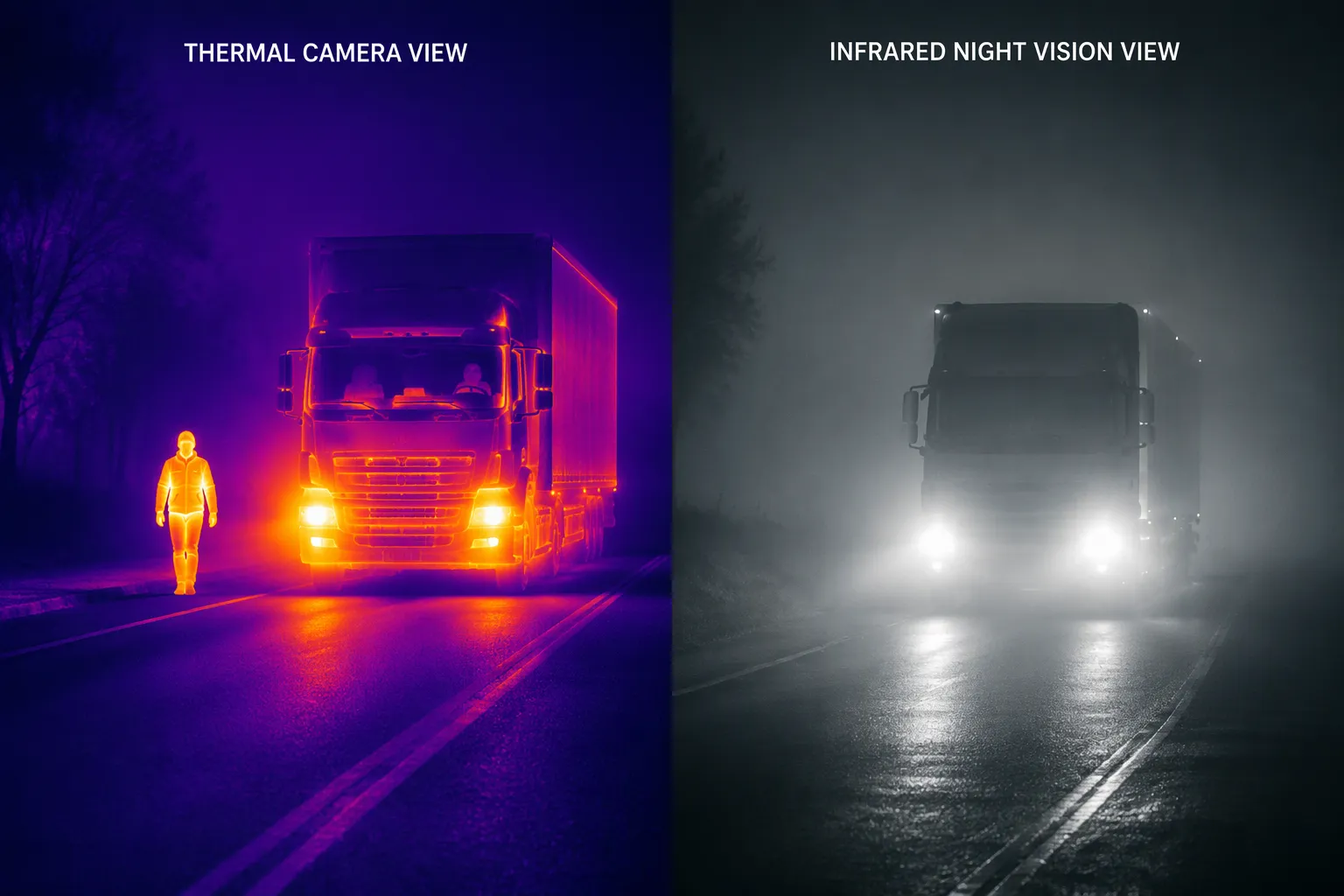
Thermal imaging detects heat. Infrared night vision relies on near-infrared illumination or light amplification. This shapes trade-offs between thermal imaging and night vision.
The right night vision camera for a commercial vehicle depends on the task and conditions, not on which technology is universally better. This article compares infrared vs night vision on working principle, real-world conditions, compliance, cost, and fit for night driving, security, and fleet operations. A thermal camera and a night vision system serve different jobs. Night vision suits some scenes; a thermal camera suits others. Night vision buyers should match each night vision tool to the task. Infrared night vision choice is task-driven. Night vision fits set conditions.
Key Takeaways
Thermal cameras detect heat and work in total darkness.
Night vision cameras need light and show scene details clearly.
Choose thermal for spotting people in unlit areas.
Choose night vision for reading signs in lit areas.
Match the camera to your specific task and conditions.
How Thermal Imaging and Night Vision Cameras Work
Thermal Imaging Principle
Thermal imaging is a form of infrared imaging. It captures infrared radiation and converts that energy into a thermal image, also called a thermogram. Every object emits a heat signature. A thermal camera measures this infrared energy and maps it into colors that represent surface temperature. An optical system focuses the energy onto a detector chip with thousands of pixels. The camera then sends a color matrix to the display as a picture.
A thermal camera needs no light at all. It reads temperature differences, not reflected light. This is why a thermal image can show a person against a cold background. The key spec is thermal sensitivity, measured in millikelvins. A lower value means the thermal camera can separate smaller temperature differences. That matters for spotting a pedestrian’s body heat against a cold road. Most commercial vehicle thermal cameras use an uncooled microbolometer sensor. This sensor operates in the long-wave infrared band, typically the 8–14 µm LWIR band. The LWIR band is where a long-wave infrared thermal camera detects emitted heat. An LWIR thermal camera does not depend on any illuminator. This article compares thermal imaging against active infrared night vision, not against every infrared method.
Night Vision Camera Principle
A night vision camera using active infrared adds its own invisible near-infrared light. The illuminator emits light in the 700–1,000 nm range, just beyond what the human eye sees. A near-infrared night-vision camera then captures the reflected light with a sensitive sensor. The result appears as a monochrome image on a normal display. Light-amplification night vision works differently. It boosts existing ambient light instead of adding its own. Both approaches produce a black-and-white image.
The wavelength distinction matters. Near-infrared night vision and long-wave infrared thermal cameras detect different wavelengths. A night vision camera relies on illumination and reflectivity. A thermal camera relies on emitted heat. A visible CMOS and LWIR pairing can combine both views. Thermal contrast drives what a thermal camera shows. Reflected near-infrared light drives what a night vision camera shows. Each principle shapes where the technology fits.
Infrared vs Thermal Camera Performance
Darkness, Fog, and Smoke
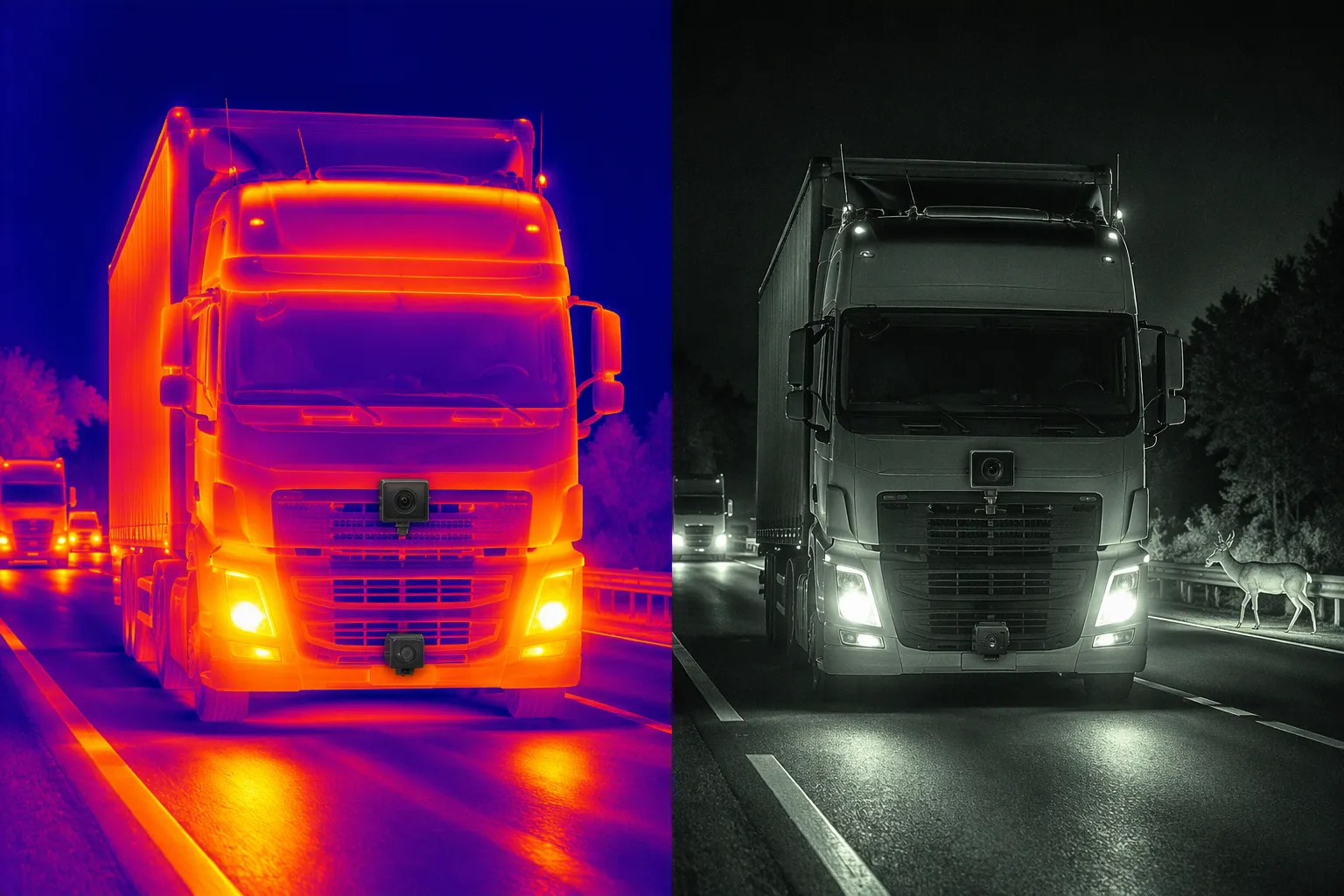
Total darkness separates the two technologies less than buyers expect. An infrared vs thermal camera comparison shows both work with no ambient light. A night vision camera supplies its own near-infrared illumination, and a thermal camera reads emitted heat. The difference appears in what sits between the lens and the target.
An infrared vs thermal camera evaluation in fog, smoke, and dust favors heat detection. Thermal imaging reads temperature difference rather than light, so it holds up through light fog, dust, and smoke better than an optical system does. An infrared night vision beam scatters off airborne particles near the lens and washes out the picture. An infrared camera also depends on light reflecting back from the target. Smoke and dust absorb and scatter that light before it returns.
The thermal imaging advantages grow in smoke-filled yards and dusty work sites. A thermal imaging camera builds a thermal image from heat given off by people, engines, and animals. Those signatures stay visible against cooler surroundings. An infrared vs thermal camera test in a smoke-filled depot usually shows the thermal image holding shape while the illuminated scene softens. Neither technology penetrates solid cover, and heavy fog degrades both. Performance in darkness is comparable; performance through airborne obstruction is not.
Range and Obstruction Handling
Range depends on physics, not marketing. An infrared night vision illuminator has a finite usable distance, and its beam weakens with distance and scatter. A thermal camera detects heat that reaches its sensor, so its reach follows thermal contrast between target and background. An infrared vs thermal camera comparison therefore shifts with the scene.
Thermal imaging can reveal heat signatures of pedestrians, animals, and disabled vehicles beyond headlight reach. A person standing on an unlit shoulder shows as a warm shape against a cold road. An infrared vs thermal camera review of forward awareness usually credits thermal imaging with earlier detection at distance. Active infrared depends on illumination reach and reflection quality. A retroreflective sign returns light strongly; dark clothing returns little.
Obstructions limit both. An infrared vs thermal camera trial in brush shows identical results: neither sees through solid barriers.
Thermal optics cannot see through solid walls, and thick brush blocks a heat signature the same way it blocks light. Thermal only shows heat that reaches the sensor.
An LWIR thermal camera also struggles with ordinary window glass, which blocks useful long-wave infrared transmission. An infrared camera generally views through glass depending on lighting. An infrared vs thermal camera decision for side or rear coverage should account for this. An LWIR thermal camera suits exposed mounting positions. An infrared vs thermal camera plan for enclosed cabs needs care. The LWIR band offers no advantage behind glass, and an LWIR thermal camera mounted inside a window loses its view. An infrared vs thermal camera comparison is therefore conditional, not absolute. An LWIR sensor excels at heat detection in open air. An infrared vs thermal camera pairing covers more tasks than either alone. The LWIR thermal camera remains one tool among several.
Near Infrared vs Thermal Imaging Conditions
When Each Excels
Near-infrared night vision needs some reflectivity and illumination. A night vision camera lights the scene and reads the light that returns. An infrared vs thermal camera choice therefore starts with the scene itself. Reflective plates, painted markings, and printed information on signs and vehicles return near-infrared light well. An infrared camera renders those details close to how the eye sees them. Faces and clothing also look natural in a night vision image. That makes an infrared vs thermal camera pairing useful for identification work. A thermal camera shows heat, not print, so a thermal image of a sign reveals little text.
Thermal imaging needs a temperature contrast instead. A warm pedestrian against a cold road gives a thermal camera a clear target. An infrared vs thermal camera comparison in an unlit yard favors the thermal camera for spotting people and engines. The near infrared vs thermal imaging split is thus about reflected light versus emitted heat. An infrared vs thermal camera test on a lit loading dock may favor night vision for detail. The same infrared vs thermal camera test on a dark shoulder favors the thermal camera. A night vision camera also benefits from existing optics, since many HD glass lenses already pass near-infrared light. The near infrared vs thermal imaging decision follows the task, and an infrared vs thermal camera review should say so.
Environmental Limits
Each technology has conditions where it struggles. Heavy rain scatters near-infrared light and cuts the reach of an infrared night vision beam. A thermal camera can also lose contrast in rain, yet it often remains usable for detection. The near infrared vs thermal imaging gap widens in smoke and dust. Longer wavelengths scatter less, so a thermal camera holds shape where an infrared camera softens. A night vision camera still wins on scene detail in clear air.
Condition | Night Vision | Thermal Camera |
|---|---|---|
Fog and heavy rain | Performance drops from light scatter | Can lose contrast, often usable for detection |
High humidity | — | Sensitivity can fall as temperature differences flatten |
Background heat | — | Warm ground and rocks reduce thermal contrast |
Mixed terrain | Favored for confirmation | Favored for detection in clutter |
One thermal imaging downside deserves mention. Uniform-temperature scenes flatten the thermal image, and warm ground complicates interpretation. An LWIR sensor reads the LWIR band well in open air, yet an LWIR camera gains nothing behind glass. The near infrared vs thermal imaging answer stays conditional. Performance in darkness is similar for both. An infrared vs thermal camera plan should match each tool to its conditions.
Compliance and Cost for Commercial Vehicles
Regulatory Factors
Compliance starts with installation. A forward-mounted thermal camera must not block the driver’s view or interfere with existing safety equipment. Mounting height and angle affect how an infrared vs thermal camera performs in service. Fleet managers should confirm that any night vision device meets local road-use rules before purchase. Some jurisdictions restrict display screens visible to the driver while a vehicle is moving. A thermal camera feed shown on a cab monitor may fall under those rules. Data handling deserves equal attention. A night vision system that records footage raises privacy questions. An infrared vs thermal camera setup that outputs detection data needs a clear policy on storage and access. Buyers should ask suppliers for documentation on electromagnetic compatibility. An infrared vs thermal camera installation can affect other electronics. A night vision unit with a heated window or wiper assembly adds mechanical complexity. The LWIR band itself carries no special license burden. An LWIR sensor still needs proper housing and sealing. An infrared vs thermal camera review should include these practical checks. A night vision purchase decision should rest on documented compliance, not marketing claims.
Cost and Applicable Conditions
Cost drivers differ by technology. A thermal camera costs more at the sensor level. An LWIR microbolometer is a specialized component, and an LWIR detector sets much of the unit price. A night vision camera costs less at the sensor level. Its illuminator adds cost, and illuminator quality varies widely. An infrared vs thermal camera budget comparison should separate sensor cost from integration cost. A thermal camera needs calibration and careful lens selection. A night vision camera needs clean optics and a stable power supply. Maintenance shapes long-term cost. An LWIR sensor has no illuminator to fail. A night vision illuminator can degrade or collect dirt. An infrared vs thermal camera total cost view should include service access. An infrared vs thermal camera choice also depends on mounting conditions. An LWIR camera suits exposed exterior positions. A night vision camera suits positions with reflective targets. An infrared vs thermal camera plan should match each unit to its duty cycle. A thermal camera running continuously draws steady power. A night vision system with active illumination draws power for its emitter. An infrared vs thermal camera cost review should weigh these operating conditions. An LWIR unit may justify its price in detection-focused roles. A night vision unit may fit budget-limited fleets. An infrared vs thermal camera decision stays conditional on the task.
Matching Night Vision to Vehicle Applications
Night Driving and Driver Awareness
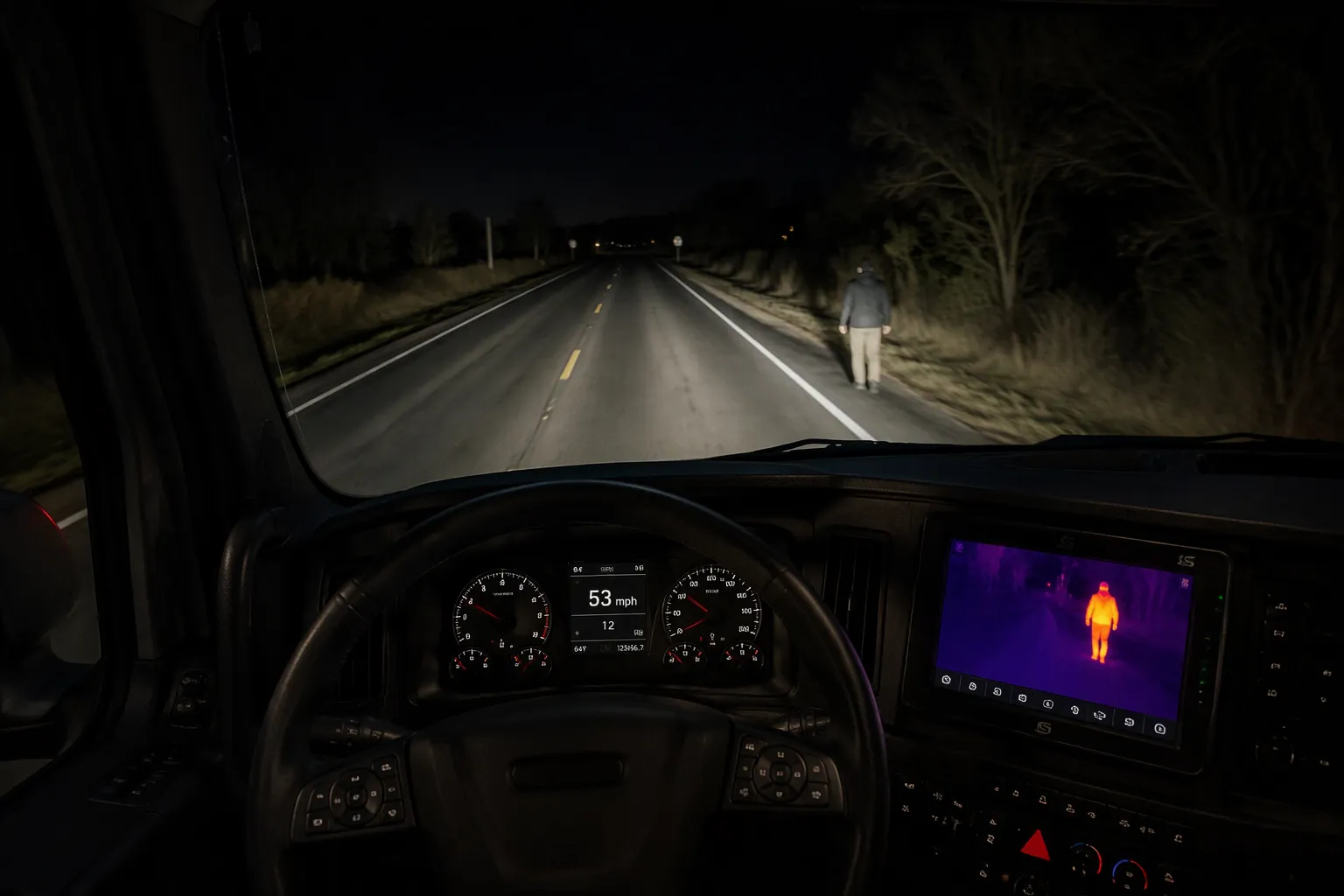
Business owners should start with the driving task. Forward awareness at night favors thermal imaging. An automotive thermal camera detects heat differences instead of reflected light. It supports night vision, ADAS, and driver-assistance functions in darkness and glare. Thermal imaging helps identify pedestrians, cyclists, and other vulnerable road users in darkness, headlight glare, and shadows. NHTSA reports more than 70% of pedestrian fatalities occur at night. That statistic alone justifies a closer look at a thermal camera for forward coverage.
A thermal camera can reveal heat signatures beyond headlight reach. Magna states its thermal sensing system can see up to four times farther than the vehicle headlight range. VSI Labs tested a thermal-fused AEB research vehicle against FMVSS No. 127 scenarios in daytime and nighttime conditions. The test vehicle passed all scenarios conducted during the program. These results show where a thermal camera fits: forward awareness of pedestrians, animals, and disabled vehicles, plus side and rear coverage.
A night vision camera fits a different job. It lights the scene and reads reflected near-infrared light. That makes it strong for illuminated scene detail, such as reading signs, markings, and vehicle shapes. A night vision camera also suits security monitoring around a parked fleet. Neither option wins everywhere. An infrared vs thermal camera plan should assign each unit to its best task.
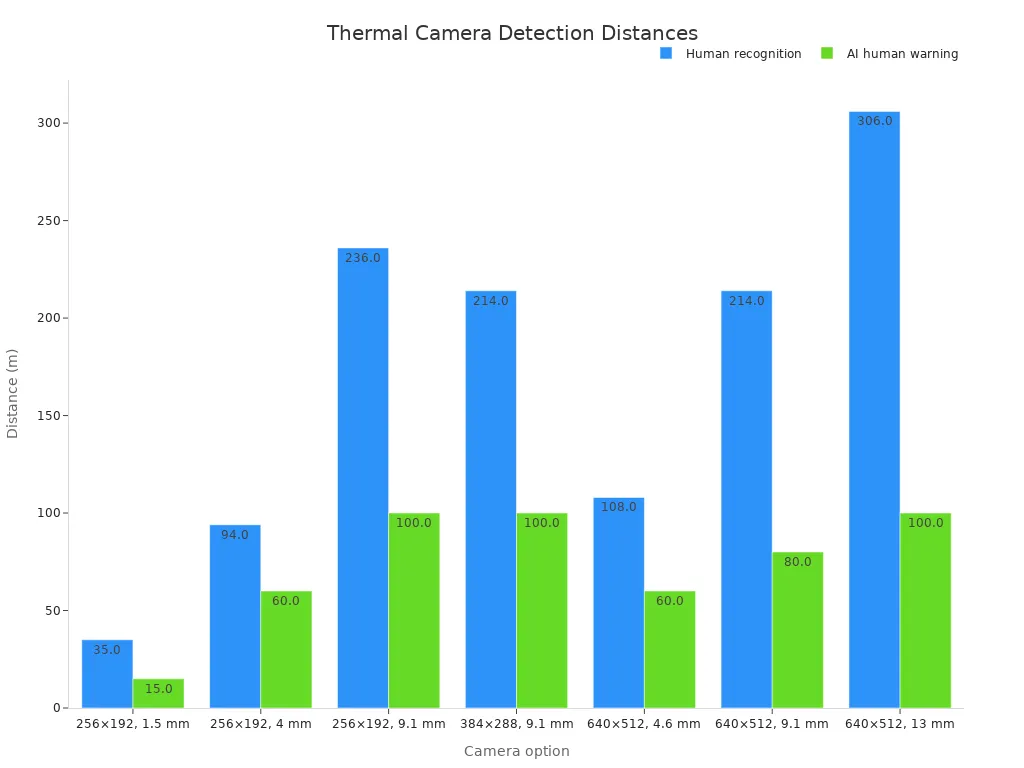
The chart below compares human recognition and AI human warning distances across seven thermal camera options.
Security and Fleet Operations
Security work rewards scene detail. A night vision camera captures faces, clothing, and printed information in a lit yard. An infrared vs thermal camera review for gate monitoring should note this strength. A thermal camera shows heat, not print, so a thermal image of a sign reveals little text. A night vision camera therefore fits perimeter checks and dock monitoring where identification matters.
Fleet operations often need both. A dual-spectrum system pairs a visible CMOS and LWIR sensor to cover detection and detail. A visible-plus-thermal setup lets a thermal camera flag a warm shape while the visible channel confirms it. TA is a camera component that provides AHD video and RS485 human/vehicle detection data. It is not a complete safety system. Treat it as one building block in a broader solution. An infrared vs thermal camera rollout should combine sensors, displays, and driver alerts.
An LWIR sensor suits exposed exterior positions. An LWIR camera reads emitted heat with no illuminator. An infrared vs thermal camera comparison for side and rear coverage should account for glass, which blocks LWIR transmission. An infrared vs thermal camera plan for enclosed cabs needs care. An infrared vs thermal camera choice stays conditional on the task. An infrared vs thermal camera decision should match each unit to its duty cycle. An infrared vs thermal camera review should weigh detection against identification. An infrared vs thermal camera strategy should pair a thermal camera for detection with a night vision camera for detail. An infrared vs thermal camera framework keeps both tools in service.
Installation, Interfaces, and Comparison Testing
Mounting and Integration
Mounting stability directly affects image quality. Vibration causes blur, connector fatigue, and calibration drift. A rigid bracket with corrosion-resistant fasteners, strain relief, and sealed cable glands protects the thermal camera. Installers should measure camera height, pitch angle, yaw angle, and bumper clearance for each vehicle type. They record these values in an installation drawing. Replacement cameras then align consistently. Ordinary glass attenuates long-wave infrared energy, so an lwir thermal camera needs an exposed position. A night vision camera can sit behind glass in some cases. The workshop sequence starts with power isolation. Technicians install the bracket at approved points, route the harness away from exhaust heat and sharp edges, add the specified fuse, and align the camera against a defined target. They repeat alignment after windshield replacement or bumper repair. A calibration record should list vehicle identification, camera serial number, lens type, mounting coordinates, and technician.
Interface choices shape integration. An AHD camera sends 720p or 1080p video over a single coax cable. An RS485 link carries detection and distance data using Pelco-D or Pelco-P protocol. Baud rates self-adapt across 2400, 4800, 9600, and 19200. A night vision camera with AHD output connects to most cab monitors. An lwir thermal camera may use Ethernet with RTSP and ONVIF instead. Buyers should confirm that the display accepts the camera’s output format before purchase. A night vision unit and an lwir unit often need different cabling and connectors.
Running a Fair Side-by-Side Test
A fair comparison uses the same route, same conditions, and same recording setup. The test evaluates each camera against the defined observation task. Testers turn off visible lighting and record the same scene with the 850 nm source both on and off. They judge detection over a representative sequence, not a single attractive image. Automatic gain control can make a weak temperature difference look dramatic in one frame and suppress it in another. Reflections deserve a separate test. A polished metal panel can reflect a warm person in lwir and create an apparent feature that moves with the camera. Retroreflective signs can wash out nearby detail in near-infrared. Testers change the viewing angle and watch whether the feature follows the surface or the viewpoint. They retain separate channel images during testing so fusion does not conceal a weak signal. A visible cmos and lwir pairing lets the thermal camera flag a warm shape while the visible channel confirms it. The night vision channel supplies scene detail in clear air. Neither technology penetrates dense foliage or solid barriers. The test should include dark clothing, partial occlusion, roadside vegetation, and wet pavement. A night vision camera and a thermal camera each earn approval only after they pass the defined task.
Conditional Comparison Table
How to Read the Table
The table below maps an operating condition to the technology that fits it and the reason behind that fit. It is condition-based, not a ranking. No row declares a universal winner. A night vision camera and a thermal camera each appear where their physics gives them an edge.
Readers should treat each row as a starting point for their own route and site survey. The infrared vs thermal camera decision changes with the scene. A night vision unit that suits a lit depot may underperform on an unlit shoulder. A thermal camera that suits forward awareness may add little behind glass. The near infrared vs thermal imaging split follows reflected light versus emitted heat, and the table reflects that split.
Condition-Based Selection
Condition | Technology Fit | Why |
|---|---|---|
Unlit road, forward awareness | Thermal camera | Reads body heat with no light |
Lit yard, sign and plate detail | Night vision | Returns reflected near-infrared light |
Light smoke or dust | Thermal camera | Heat contrast survives scatter better |
Heavy rain | Night vision (with limits) | Beam reach shortens; detail still reads |
Enclosed cab behind glass | Night vision | Glass blocks lwir transmission |
Exposed exterior mount | Thermal camera | lwir sensor needs no illuminator |
Gate and perimeter checks | Night vision | Captures faces and clothing detail |
Mixed detection and detail | Dual-spectrum system | Pairs visible CMOS with lwir sensing |
A fleet manager should start with the observation task. Detection work favors a thermal camera. Identification work favors a night vision camera. An infrared vs thermal camera plan that covers both tasks may need two units. An lwir sensor handles heat detection in open air. An lwir camera loses its view behind glass. An infrared vs thermal camera review should note that limit. An infrared vs thermal camera rollout should match each unit to its mounting position. An infrared vs thermal camera strategy should weigh the near infrared vs thermal imaging trade-off per site. An infrared vs thermal camera framework keeps a thermal camera for detection and a night vision camera for detail. An infrared vs thermal camera choice stays conditional. An infrared vs thermal camera decision should follow the environment. An infrared vs thermal camera test confirms the fit before purchase.
Observation Tasks and Imaging vs Recognition
Defining the Observation Task
The observation task should drive the technology choice. A fleet manager who needs to spot a heat signature on an unlit shoulder has a different job than one who needs to read a plate in a lit yard. The first task rewards a thermal camera. The second rewards a night vision camera. Buyers should write the task down first. A clear task statement names the object, distance, lighting, and follow-up.
This framing keeps the evaluation honest. A night vision demo can impress a buyer whose real task is spotting a person beyond headlight reach. A thermal camera demo can impress a buyer whose real task is reading printed detail. Neither demo proves fitness; the task statement does. Target detection and tracking belongs in that statement when the fleet plans to act on camera output automatically. A thermal camera and a night vision camera each answer a different question.
Imaging Versus Recognition
Imaging means seeing a scene. Recognition means identifying and classifying an object within it. A thermal camera excels at imaging heat patterns. A night vision camera excels at imaging reflected detail. A thermal camera reads heat, not print. Recognition workflows need a label, a location, and a trigger for action.
Detection data supports those workflows. The VERYTEK TA camera component provides AHD video and RS485 human/vehicle detection data. It is not a complete safety system. Teams treat it as one building block. The RS485 port is transmit-only and sends distance data tied to detection events. Video travels on the separate AHD coax lead. Receiving platforms read the feed at these settings:
RS485 settings: 115200 baud, 8 data bits, 1 stop bit, no parity.
A night vision camera supplies the scene detail that confirms a detection. A thermal camera supplies the heat signature that starts it. A thermal camera flags the warm shape, and a night vision camera confirms the object. The roles complement each other. A thermal camera alone cannot read print, and a night vision camera alone cannot see body heat. A thermal camera paired with a night vision camera covers both halves of the task.
A thermal camera detects heat and needs no light. Infrared night vision depends on active illumination or light amplification. Each technology excels in different conditions and tasks. No option is universally superior.
Choose by operating environment, observation task, compliance needs, and budget. Treat the camera as one component of a broader safety setup. A thermal camera suits unlit forward awareness. A night vision camera suits lit scene detail. A thermal camera struggles behind glass. A thermal camera also needs thermal contrast. Match each thermal camera to its mounting position. Confirm that every thermal camera meets local road-use rules. Weigh thermal camera cost against duty cycle. A thermal camera and a night vision camera can share one fleet.
Assess fleet requirements, then consult a specialist. Submit the vehicle type, target objects to detect, and display solution for a tailored recommendation.
FAQ
Does a thermal camera work in complete darkness?
Yes. A thermal camera reads emitted heat rather than reflected light. It needs no illuminator and no ambient light. A person or a warm engine shows against a cooler background. Thermal contrast drives the image, so the scene must contain temperature differences for the camera to render useful detail.
Can infrared night vision see through fog or smoke?
No technology sees through solid fog or dense smoke. Near-infrared light scatters off airborne particles and shortens the beam reach. A thermal camera often holds shape better in light smoke or dust because heat contrast survives scatter. Neither option penetrates solid barriers or thick brush.
Which option suits forward pedestrian detection at night?
Forward awareness on an unlit road favors a thermal camera. It detects body heat beyond headlight reach. A night vision camera depends on illumination and reflection, so dark clothing returns little light. Many fleets pair both technologies to cover detection and scene detail together.
Does glass block a thermal camera?
Yes. Ordinary window glass attenuates long-wave infrared energy. A thermal camera mounted behind a windshield loses its view. Installers should place the unit at an exposed exterior position. A night vision camera can sit behind glass in some cases because near-infrared light passes through.
How should a fleet manager choose between the two?
Start with the observation task. Detection work favors a thermal camera. Identification work favors a night vision camera. Then weigh mounting position, local road-use rules, and budget. Treat each camera as one component of a broader safety setup, not a complete system.