
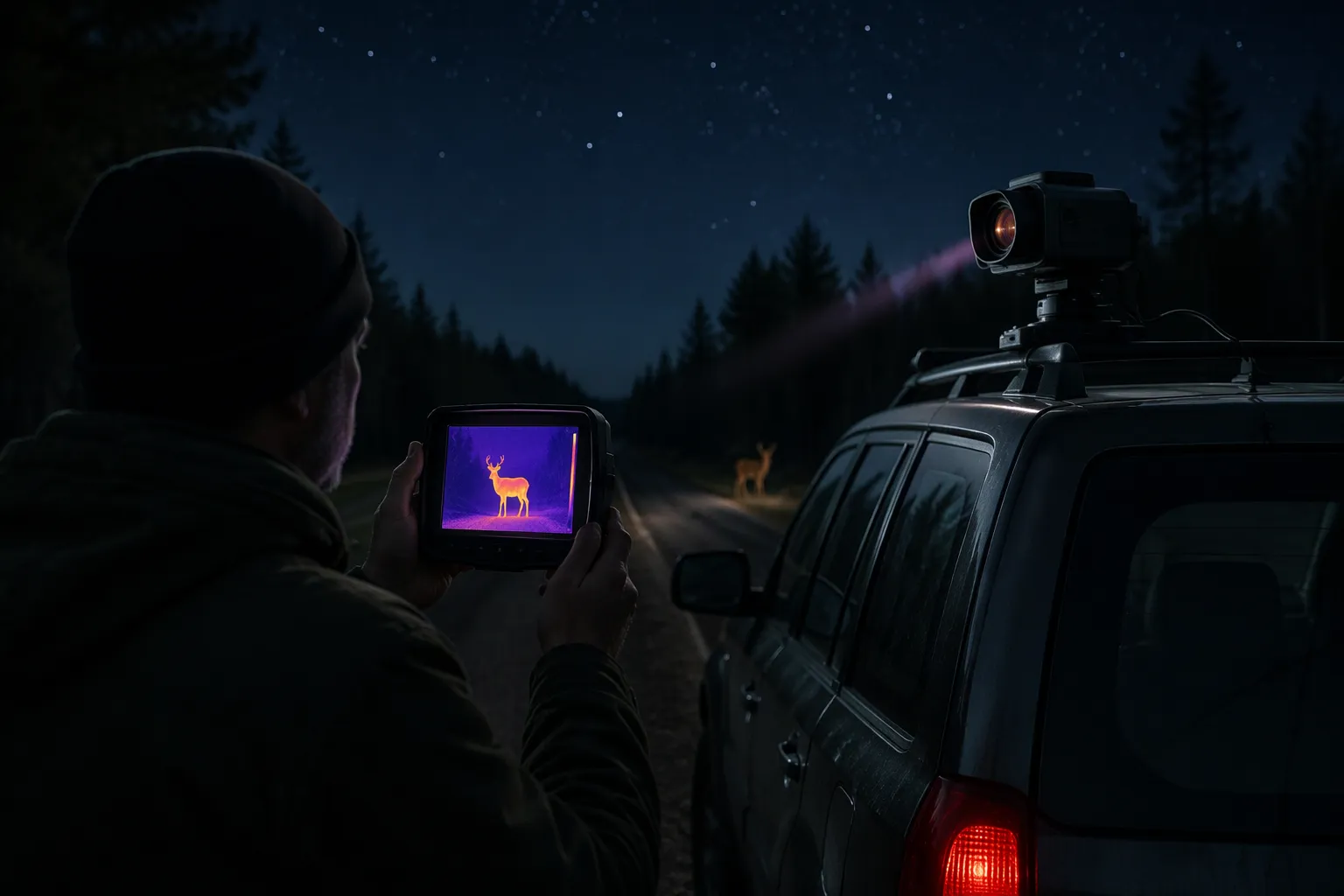
Technical teams selecting a night vision camera for commercial vehicles face a choice between thermal and active-infrared technologies. This article presents a side-by-side test of both camera types under identical conditions. The core question: which technology performs better for vehicle night observation, and under what conditions? The test measures detection range, image clarity, response time, and stability in darkness, fog, rain, and glare. It also compares application fit, regulatory compliance, and cost. Thermal cameras detect emitted infrared radiation; active-infrared cameras rely on reflected IR light. The reader acts as a decision-maker choosing a camera component, not a complete safety system. The TA camera provides AHD video and RS485 human/vehicle detection data.
Key Takeaways
Thermal cameras detect heat and work in total darkness, fog, and glare. Active-infrared cameras need light to reflect and struggle in fog or rain.
Thermal cameras see far away, over 1000 meters for people. Active-infrared cameras give clearer short-range images at lower cost.
Choose thermal cameras for long-range detection in dark or bad weather. Choose active-infrared for short-range, budget-friendly, or AI-integrated setups.
Always test cameras on your own vehicle and in your typical weather. Check detection range, image clarity, and response time for your specific needs.
Defining Thermal Cameras and Active-Infrared
How Thermal Cameras Detect Heat
Thermal cameras capture images from the heat that objects emit. Every surface above absolute zero radiates infrared energy, and a thermal infrared camera converts that radiation into a visible picture. Thermal imaging detects heat signatures rather than reflected light, so the technology works in low-light or no-light conditions. Total darkness, deep shadows, and oncoming headlights do not affect the image. Thermal cameras also see through smoke, dust, and light fog, which makes them useful in adverse visibility conditions. A thermal camera reads temperature differences directly, and it ignores visible light entirely.
The physics explains the range advantage. People and vehicles run hot against most backgrounds, so they stand out in strong thermal contrast. A thermal camera system with a longer lens reaches farther: a 50 mm lens detects human-sized targets at 4.8 km with an 8.8° horizontal field of view, while a 9 mm lens reaches 825 m with a 46.2° field. A 12 μm pixel pitch extends detection range about 40% compared with 17 μm sensors. These figures assume a standard target-to-background temperature difference, so real results vary with weather and scene contrast. Long-wave lwir cameras keep this edge in dry air, where the infrared band transmits well.
How Active-Infrared Uses Illumination
Active-infrared cameras work differently. An active infrared illuminator floods the scene with near-infrared light, and the camera images the light that bounces back. This approach produces familiar, high-contrast pictures at short range. Performance depends on the illuminator’s power and beam angle. Infrared illumination also scatters in fog and rain, so image quality drops in poor visibility conditions.
Brightness carries a second cost. An active infrared source that is too bright can glare for other drivers, so installers must aim and power it carefully. Buyers often compare thermal/infrared cameras on this point. Thermal vision needs no lamp at all, while active-infrared depends on one. Thermal cameras and active-infrared units therefore suit different observation tasks.
Night Vision vs Thermal Imaging: Clearing Up Terms
What Night Vision Usually Means
The term night vision camera covers several technologies, and buyers often use the label loosely. In common usage, a night vision device refers to image intensification or active-infrared equipment. Image intensification amplifies ambient visible light from the moon and stars. Active-infrared systems carry their own near-infrared lamp and image the light that reflects back. Both approaches depend on light, whether natural or projected, so both belong to the night vision systems family.
The distinction matters for specification. A low-light night vision camera may perform well outdoors under moonlight and struggle in true darkness. An active-infrared unit works in complete visible darkness, yet its range stays limited by illuminator power, beam angle, and atmospheric conditions. Typical ranges run from 30 m to 200 m for near-infrared and 100 m to 500 m for image intensification, depending on generation and hardware.
Where Thermal Imaging Fits
Thermal imaging and night vision are sometimes used interchangeably, but they are not the same. The key difference between thermal imaging and night vision lies in the physical signal each one reads. Thermal imaging also uses infrared bands, specifically the long-wave infrared region, yet it detects radiation emitted by objects rather than light reflected from them. It needs no illuminator and works in total darkness.
This difference shapes image content. A thermal image shows temperature contrast, so it may reveal that a person is present without showing clothing color or facial features. Typical thermal range reaches 200 m to 2000 m depending on the detector. Night vision and thermal imaging therefore answer different questions: one confirms visual detail, the other finds heat signatures. Neither term is more correct; each describes a distinct sensing method.
Identical Installation and Test Conditions
Vehicle Setup and Camera Mounting
Both camera types went onto the same commercial vehicle platform at the same position and angle. The team parked the vehicle on a level surface with normal tire pressure and its usual operating load. They marked the centerline, measured camera height from the road, and recorded the lens-to-bumper distance. A digital angle gauge recorded pitch and yaw, with the lens facing forward at zero yaw relative to the centerline. A small intentional downward pitch may be needed to include the near-field zone, and the team recorded that angle for calibration. Alignment came from measurement, not from body trim, because bumper panels can be asymmetric.
The team tested a temporary mount first, then installed a torsion-resistant bracket with coated automotive-grade fasteners. Cable routing stayed away from ignition coils, high-current motor wiring, and exhaust components. Thermal cameras generate heat, so the housing sat where airflow could carry it away. The active-infrared illuminator sat high and far forward to throw a clean beam and avoid hood reflection. The TA camera provides AHD video and RS485 human/vehicle detection data as a component output. It is a camera component, not a complete safety system.
Test Environments: Darkness, Fog, Rain, Glare
The test matrix covered four conditions: total darkness, fog, rain, and oncoming glare. Each run used the same route, the same measured target distances, and the same recording settings. Warm targets and people stood at measured distances where safe and legal. The team checked whether the hood, grille bars, or wiper entered the image. They repeated the static alignment check before each condition and logged camera height, pitch, yaw, lens type, and firmware version.
Thermal cameras read emitted radiation in the infrared bands, so darkness and glare did not change their signal. The thermal camera system held its image through fog and light dust. The thermal camera also ignored oncoming headlights. Active-infrared units depended on reflected near-infrared light, and fog and rain scattered that light. Glare tests therefore separated the two technologies clearly. The team rechecked the bracket after the first 100–200 km and after any bumper contact, since a small shift can move the far-field image.
Goals and Evaluation Criteria
Detection Range and Image Clarity
The test measures detection range, image clarity, and reliability for vehicle night observation. Range defines how far a camera can reveal a person or vehicle before the driver reacts. Clarity defines whether that target is recognizable or merely a blur. The team scores both against a fixed target set at measured distances, and it records the conditions beside every result.
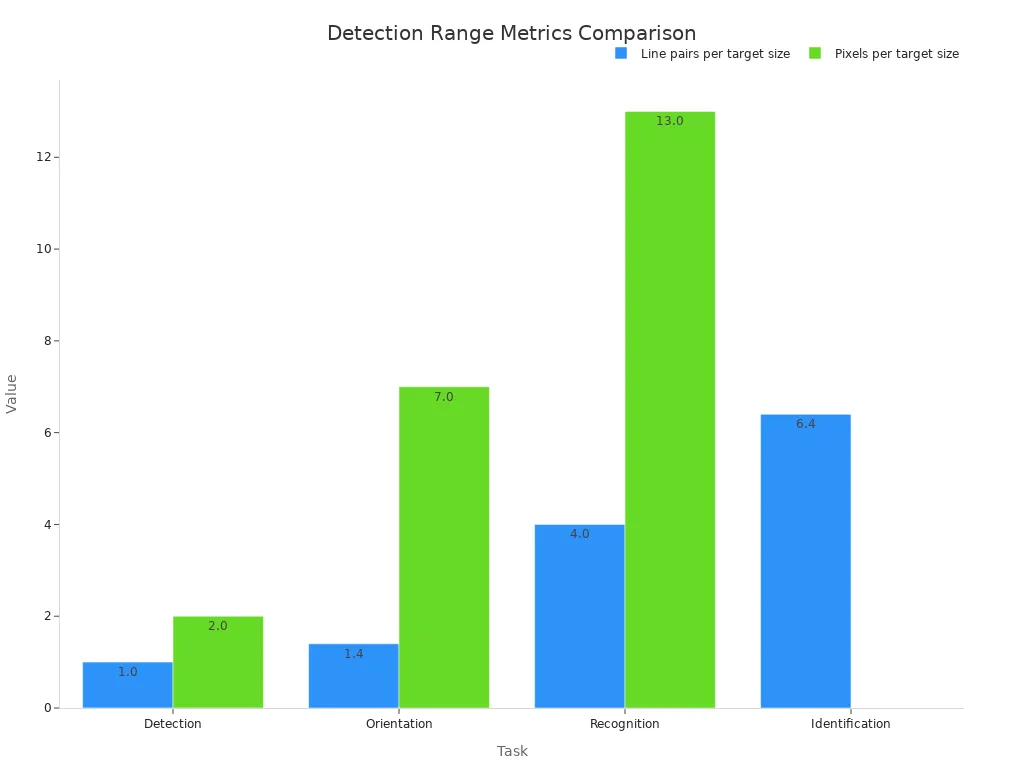
Range prediction follows a geometrical model. Detection needs 2 pixels per target size, recognition needs 7 pixels, and identification needs 13 pixels. Laboratory MRTD measurements apply STANAG 4347: a 50% probability for two target sizes, human and vehicle, with a 2 K temperature difference between target and background and an atmospheric absorption coefficient of 0.2 per km. These sample conditions matter, because a warmer target or clearer air shifts the result.
Sensor choice sets the ceiling. A 640×480 sensor carries four times the pixel density of a 320×240 unit, so more pixels land on the target. A lower NETD, ideally under 40 mK, sharpens the image in fog, rain, and high humidity. Thermal cameras in the long-wave infrared band pass radiation through smoke, fog, dust, and light rain with far less scattering. Under those poor visibility conditions, thermal cameras often detect personnel beyond 1000 m and vehicles beyond 2000 m.
Reliability and Response Time
Response time covers two clocks: the frame refresh and the detection output. A 50 Hz or 60 Hz refresh rate gives smooth video, while 30 Hz or less looks choppy and lags behind a moving scene. The thermal camera system must also hold a stable image through vibration and temperature swings. Standard electronics typically rate for about -20°C to +50°C, and rugged long-wave units tolerate much wider extremes.
Stability in adverse visibility conditions separates the technologies. The thermal camera reads emitted radiation, so darkness, glare, and light obscurants leave its signal largely intact. Active-infrared units depend on reflected light, and fog and rain scatter that light. The team logs dropouts, image flicker, and detection latency for each run. It also checks that object detection and object tracking outputs stay consistent as targets cross the field of view.
Visibility vs AI Detection
Human Visibility Performance
A human operator and a machine read the same video feed in different ways. Human-visible image quality covers what an operator can interpret on a monitor: shape, contrast, and recognizable detail. Night vision systems generally produce images that are easier to interpret for fine identification work, such as reading license plates or distinguishing individual features. The image resembles what an operator expects to see. Thermal cameras build contrast from minute heat differences between objects, so people stand out against a dark background. That contrast supports detection, yet fine visual detail stays lower. The thermal camera therefore excels at finding a target, while night vision helps confirm what that target is.
Machine Vision and Vehicle Detection and Tracking
Machine-readable output follows a separate path. The TA camera delivers RS485 human/vehicle detection data as a component output, and that data supports vehicle detection and tracking. A control board processes the RS485 stream and converts it into mechanical movement, and common protocols cover VMS, GUI, ONVIF, IP, Ethernet, fiber, microwave, analog, digital, and wireless links. Thermal image data can also train machine learning detectors, which extends the same output to new scenes.
Detection range sets the working envelope. Thermal detection reaches beyond 2000 m for a human target and beyond 4000 m for a vehicle, with longer ranges available. Multi-sensor fusion combines visible and infrared feeds for better situational clarity, and AI video analytics add auto-tracking, intrusion detection, and behavioral analysis. The thermal camera system keeps object detection and object tracking consistent as targets cross the field of view. Teams should treat object detection and object tracking as separate benchmarks, because a detector that finds a person may still lose that person between frames. Thermal cameras thus serve both the operator and the algorithm, and each audience needs its own acceptance test.
Test Record Table
Table Structure
The test record table organizes every run into one row, so the team can compare results across camera types and conditions without hunting through separate logs. Each row pairs a camera type with a single test condition. The detection range column records the farthest measured distance at which the target met the scoring threshold. The clarity column captures the operator’s rating against the fixed target set. The response time column holds the measured latency from target entry to detection output. The notes column carries the context that makes a number meaningful: lens focal length, sensor resolution, target-to-background temperature difference, and any dropout or flicker observed.
How to Read the Results
Readers should compare rows only within the same condition. A thermal row recorded in total darkness and an active-infrared row recorded in fog answer different questions, and pairing them directly misleads. The notes column deserves attention first, because a range figure without its sample conditions cannot be checked or reproduced. Teams should also read the clarity and response time columns together. A camera that reaches far but returns a slow detection output gives the driver less reaction time than the range alone suggests.
The empty cells are intentional. The team fills them from measured runs, not from datasheet estimates, and it keeps the raw recordings alongside the table. A completed table lets a reader match each technology to their own operating profile: the thermal rows show performance where emitted radiation carries the signal, and the active-infrared rows show performance where reflected illumination does.
Test Limitations
Environmental and Equipment Constraints
Sensor resolution and lens focal length set hard limits on every result. A 640×480 sensor resolves more detail than a 320×240 unit, and a longer lens trades field of view for range. The temperature difference between target and background also shifts outcomes. A warm pedestrian against a cold road stands out clearly, while a target close to ambient temperature fades. The team records these parameters beside each run, so readers can judge how far a result transfers to their own hardware.
Snow remains a weak spot in the test set. Published studies on snow and its interaction with the camera are scarce, largely because snow-based simulators are rare. Snow affects the mechanical operation of an externally mounted camera, and moisture below freezing point forms thin ice layers on the lens. A camera placed inside the windshield faces a different problem: falling snow with varied shapes is hard to trace and remove during image processing, which degrades target recognition.
What the Tests Do Not Cover
The results do not cover all weather, all vehicles, or full safety-system validation. Thermal cameras in the far-infrared spectrum lack a well-established public database and reliable benchmarking protocols for pedestrian and vehicle detection, classification, and tracking. That gap makes it hard to test algorithms against well-known automotive road scenes across varied weather and lighting. The team also left some points outside the analysis: classification of bicycles, light poles, and pedestrians can confuse sensors, and the response time for slow-moving pedestrians and small objects deserves separate attention. Potholes and pitfalls in adverse climates need their own study.
Edge cases carry low probability and poor repeatability. Recent reports note that empirical field experiments cannot validate autonomous vehicle safety on an acceptable timescale. Virtual testing can bridge that gap in a controlled, rapid manner, yet the research community still recognizes the difficulty of generating realistic scenarios that mimic the physical world through software alone. The thermal camera system in this test therefore offers a component benchmark, not a safety certification. Teams should treat object detection and object tracking results as starting points and confirm them in their own operating conditions.
Direct Comparison: Thermal vs Active-Infrared
Technical Performance
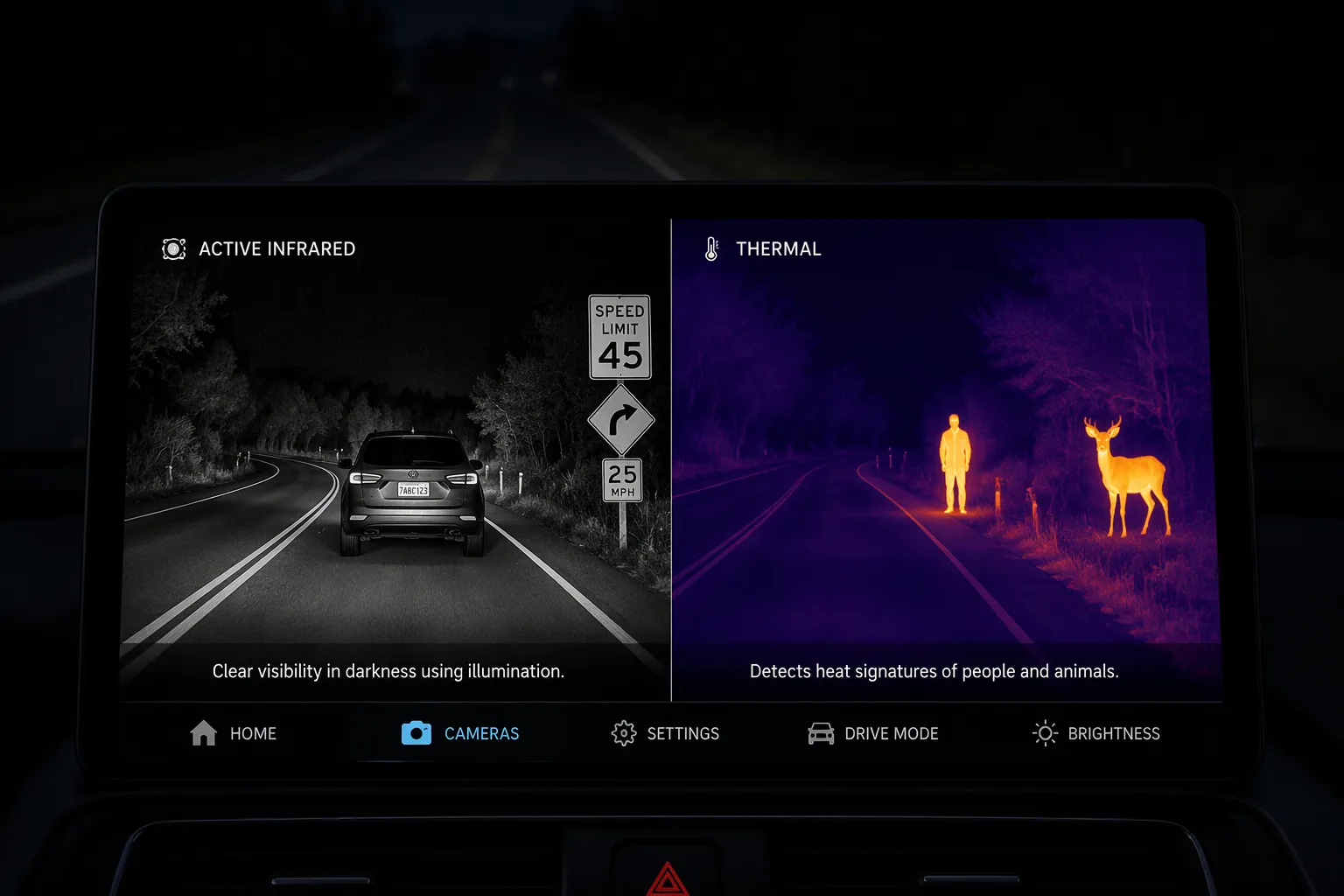
The two technologies diverge most sharply in how they handle light. Active-infrared units emit near-infrared illumination and image the light that reflects back. Thermal cameras read emitted heat and need no external source. That difference decides performance in total darkness: active-infrared needs some ambient light to work effectively, while thermal cameras work in complete darkness. Fog, smoke, and dust scatter reflected light and cut active-infrared visibility. Heat energy penetrates those obstacles, so thermal cameras hold their image in adverse visibility conditions. Short-range clarity favors active-infrared, which produces clear, detailed images with sharp contrast; road signs and number plates stay identifiable. Heat-based images look more abstract and carry less fine detail. Range favors the heat-based approach, which detects well beyond the reach of headlights. Atmospheric absorption and scattering still limit that range in poor visibility conditions. A team should record the sample conditions beside every figure, because a warmer target or clearer air shifts the result.
Terminology deserves a note. Night vision vs thermal imaging is not a contest of quality; the two sense different signals. Thermal imaging and night vision answer different questions, and a team that conflates them will misread the test table.
Application Fit
Application fit follows from those physics. The heat-based approach suits long-range pedestrian detection in total darkness and low-light or no-light conditions. The technology also supports animal detection in general, though the TA camera’s listed output covers human and vehicle detection only. A thermal camera pairs well with machine learning pipelines, and heat image data can train detectors for object detection and object tracking. Vehicle tracking benefits from the stable contrast a thermal camera system provides. Thermal imaging performance does carry limits: atmospheric absorption narrows effective range in bad weather, and high-resolution units remain costly. Thermal cameras remain the stronger choice where heat contrast carries the scene. The heat-based approach reads a thermal signature directly.
Active-infrared suits cost-sensitive, shorter-range deployments. Short-pulse laser illumination with a gated camera is an established vehicle approach, and active infrared enhances camera performance in complete darkness. Consumer and recreational markets prioritize cost-effectiveness and ease of integration. A night vision camera of this type costs far less: consumer active-infrared units run $50–$500 against $300–$1,000 for heat-based units, and commercial active-infrared units run $500–$2,000 against $3,000–$15,000 or more. Active-infrared cameras cost roughly 5–10 times less than heat-based equivalents.
Regulatory compliance differs by region and use. FMVSS No. 127 requires pedestrian automatic emergency braking on passenger cars and light trucks up to 10,000 pounds by September 2029, and it demands pedestrian detection in varied lighting. NHTSA FARS data cited in published testing attributes 77.7 percent of pedestrian fatalities in 2022 to nighttime conditions. Export rules add another layer: some modules ship ITAR-free and NDAA-compliant, while certain camera notes cap radiant sensitivity at 10 mA/W for wavelengths exceeding 760 nm and restrict civilian vehicle placement to vehicles under 4,500 kg gross weight.
Neither option wins outright. Each fits a defined operating envelope.
Which Technology Fits Which Scenario
Best Use Cases for Thermal Cameras
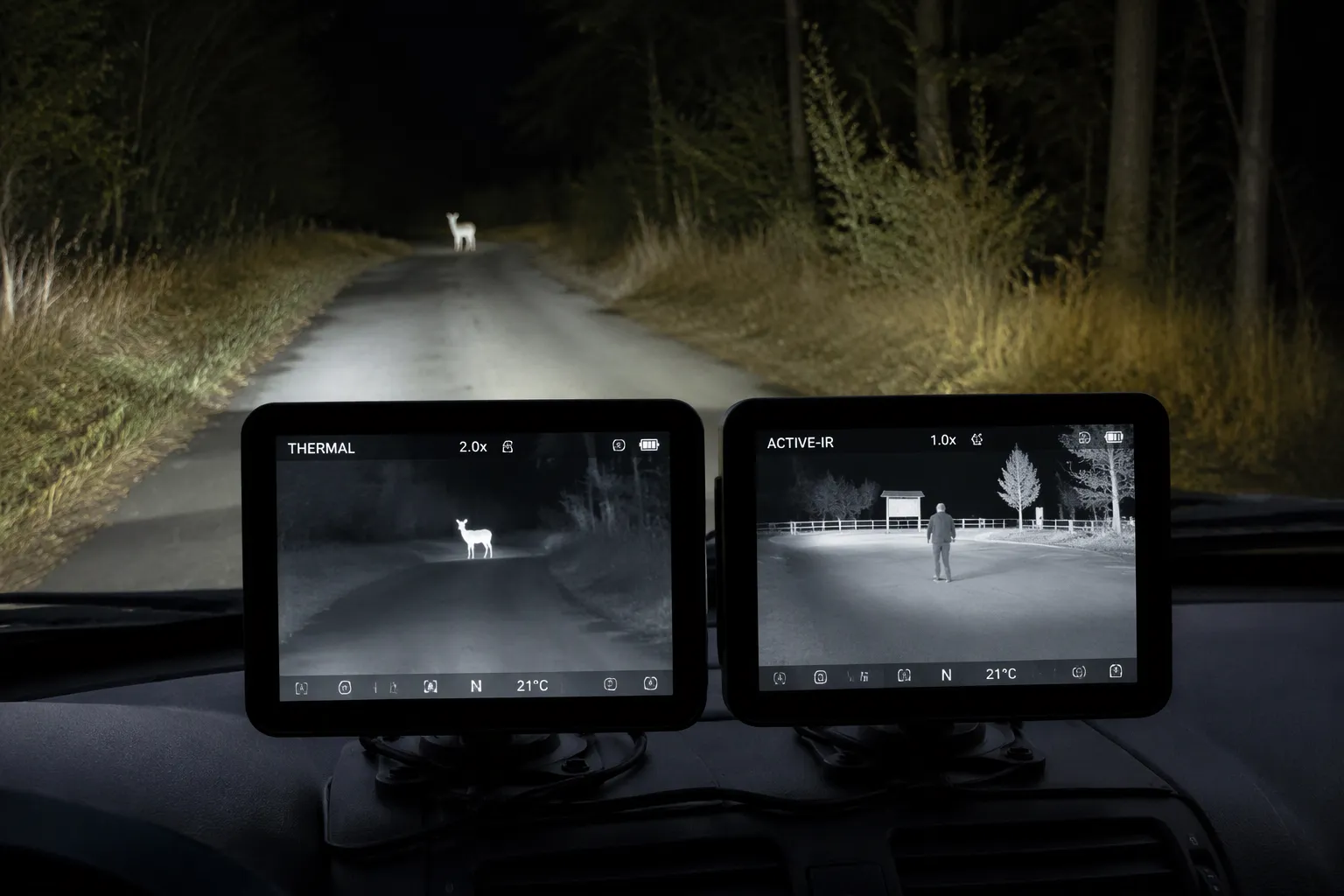
Thermal cameras answer one question well: is something out there? They read emitted heat rather than reflected light, so they hold their image in total darkness, smoke, fog, light rain, and tall grass or brush. Long-wave infrared units, operating from 8000 to 14,000 nanometers, also resist direct sunlight. A study cited in published research found long-wave infrared outperformed lidar and RGB cameras for identifying pedestrians in fog. These traits map to four operating profiles:
Night driving and collision avoidance on wildlife-heavy roads, blind curves, and open range, where detection reaches beyond 1,000 yards for large animals.
Perimeter and rapid-response patrol work, where a crew scans a large property in minutes and spots human heat signatures through fences, vehicles, and vegetation.
Search and rescue, where responders locate missing persons and read hazards at accident scenes.
Zero-light routes, where no lamp exists to reflect and the scene stays readable anyway.
The technology excels at detection, not identification. Images show heat signatures rather than faces or plates. The U.S. Department of Homeland Security notes this detection-at-scale role in perimeter security and border monitoring. Teams weighing a night vision camera for long-range warning should treat that limit as a design input, not a defect. The TA camera’s listed output covers human and vehicle detection only, so buyers should not assume animal detection from that component.
Best Use Cases for Active-Infrared Cameras
Active-infrared fits a different envelope. An illuminator projects near-infrared light, and the camera images the reflection. Short-range work benefits most: parking approaches, low-speed maneuvering, and near-field monitoring where the beam reaches the target. Cost drives many selections, since active-infrared units run far below heat-based equivalents. Integration drives the rest. A night vision device of this type pairs naturally with AI pipelines, and the TA camera returns RS485 human/vehicle detection data that supports object detection and object tracking. Teams building night-time autonomous driving prototypes often start here, because the visible-style image is easier to label and debug.
Sample conditions still govern every figure. Fog and rain scatter projected light, so range claims need the weather beside them. A thermal camera system holds contrast where reflected light fails; an active-infrared unit wins on detail where the air stays clear. Neither choice is universal. The thermal camera suits long-range warning in low-light or no-light conditions and adverse visibility conditions. Active-infrared suits short-range, budget-conscious, and AI-integrated builds. Match the camera to the route, the required warning distance, and the budget, then confirm the result on the vehicle.
Call to Action
Next Steps for Readers
The test record table gives readers a starting point, not a final answer. Each row pairs one camera type with one condition, and the notes column carries the parameters that make a figure meaningful: lens focal length, sensor resolution, and the temperature difference between target and background. Readers should pull the rows that match their own routes and weather. A fleet that runs dark rural highways reads the total-darkness rows first. An urban operator that fights glare and rain weighs those columns more heavily. Thermal cameras hold contrast where reflected light fails, so the darkness rows deserve close attention. The same table shows where active-infrared returns sharper detail at short range.
Readers should then repeat the alignment checks on their own vehicle. Camera height, pitch, and yaw shift the far-field image, and a small bracket movement changes what the lens sees. Thermal cameras read emitted radiation in the infrared bands, so hood reflection and headlight glare matter less for them than for an illuminated unit. Teams should log their own sample conditions beside every result.
Choosing Based on Your Needs
Selection starts with three inputs: the required warning distance, the operating weather, and the budget. Long-range detection in total darkness points toward a thermal camera. Short-range, cost-sensitive work with an AI pipeline points toward active-infrared. The TA camera returns AHD video and RS485 human/vehicle detection data, and that stream supports object tracking on a host system. Buyers should confirm the listed detection classes before they plan around them.
The team welcomes questions on TA camera specifications and on the RS485 detection data format. Readers can send their target type, installation location, and display system for a tailored recommendation.
Neither technology wins. Thermal cameras read emitted heat and hold contrast in total darkness and adverse visibility. Active-infrared units return sharper short-range detail at lower cost. Choice depends on scenario, required detection range, environmental conditions, and budget. Long-range detection in total darkness favors thermal cameras. Cost-sensitive, shorter-range, or AI-integrated setups favor active-infrared.
The TA camera is a component. It provides AHD video and RS485 detection data, not a complete safety system. Both thermal and active-infrared keep improving for commercial vehicle night observation. Automotive thermal reaches beyond 300 meters, against 100 to 150 meters for conventional headlights, and long-wave infrared penetrates dust and fog. A night vision camera built on active-infrared keeps gaining range.
FAQ
How Does Thermal Imaging Differ From Active-Infrared Night Vision?
Thermal cameras read emitted infrared radiation in the long-wave infrared band. They need no light source. Active-infrared cameras project near-infrared illumination and image the reflection. One senses heat; the other senses reflected light. Sample conditions still govern every range figure.
Which Camera Holds Up Better in Fog and Rain?
Fog and rain scatter projected light, so active-infrared range drops. Thermal contrast survives those obscurants far better. A thermal camera also ignores oncoming headlights. Teams should record visibility conditions beside each result, because clear air changes the comparison.
Does the TA Camera Detect Animals?
No. The TA camera lists human and vehicle detection only. Buyers should not plan animal detection around this component. A thermal camera can support that task in principle, yet the listed output for TA covers people and vehicles alone.
What Output Does the TA Camera Provide?
The TA camera returns AHD video and RS485 human/vehicle detection data. That stream supports vehicle detection and tracking on a host system. The camera is a component, not a complete safety system. Teams must validate results on their own vehicle.
How Should a Team Choose Between the Two?
Match the camera to the route, the required warning distance, and the budget. Long-range work in total darkness favors thermal. Short-range, cost-sensitive, AI-integrated builds favor active-infrared. A thermal camera costs more, so confirm the detection classes before planning around them.